



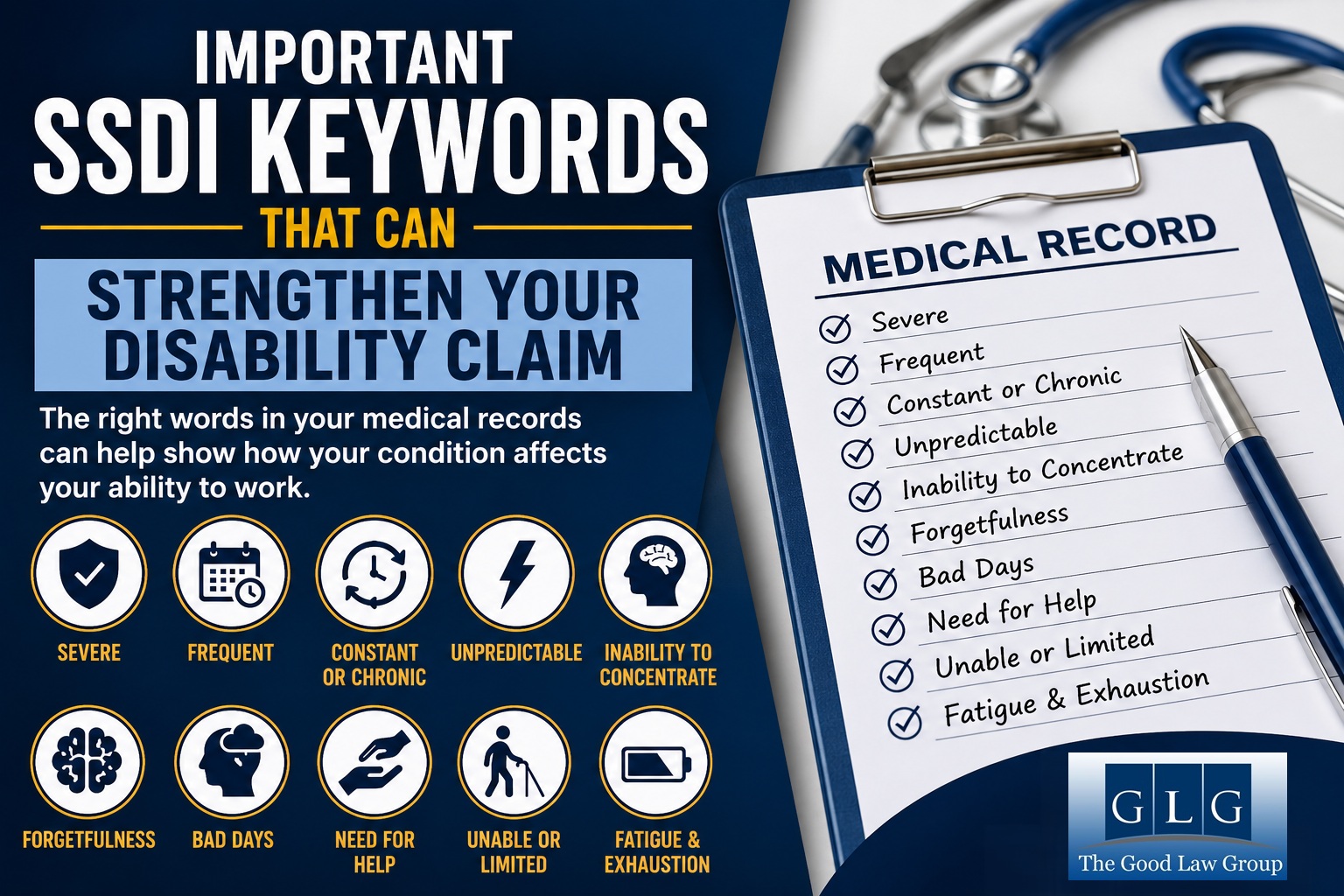
When applying for Social Security Disability Insurance (SSDI), your diagnosis matters but it isn’t the only thing Social Security looks at. The Social Security Administration wants to understand how your condition affects your ability to work. That’s why certain words and phrases appearing in your medical records can carry significant weight during the disability evaluation process.
These aren’t “magic words” that automatically get claims approved. However, when documented by your doctors, specialists, therapists, or other treatment providers, they can help paint a clearer picture of how your condition limits your daily activities and ability to maintain employment. Here are some of the most important terms that can strengthen an SSDI claim.

Severe
One of the first questions Social Security asks is whether your condition is severe. Under Social Security rules, a severe impairment is one that significantly limits your ability to perform basic work activities. Medical records that repeatedly describe symptoms as severe may be more persuasive than records that consistently characterize symptoms as mild or moderate. For example:
Severe back pain
Severe depression
Severe anxiety
Severe neuropathy
Severe fatigue
The severity of your symptoms helps demonstrate the extent of your workplace limitations.
Frequent
Frequency matters. Social Security is often evaluating how often symptoms occur and how those symptoms affect your ability to work consistently. Examples include:
Frequent falls
Frequent seizures
Frequent panic attacks
Frequent migraines
Frequent breaks needed throughout the day
The more frequently symptoms occur, the more difficult it may become to maintain reliable employment. For example, someone who experiences migraines once every few months presents a different picture than someone who experiences debilitating migraines three or four times per week.
Constant or Chronic
Another important term is constant or chronic. These words indicate that symptoms are ongoing rather than temporary. This is especially important in cases involving:
Chronic pain
Chronic fatigue
Chronic migraines
Chronic neurological conditions
If your pain or symptoms are constant enough to interfere with sleeping, concentrating, cooking, cleaning, shopping, or other daily activities, that information can be highly relevant to your disability claim.
Unpredictable
Many disabling conditions don’t affect people the same way every day. Some people experience symptoms that are highly unpredictable. Examples include:
Unpredictable migraines
Unpredictable seizure activity
Unpredictable autoimmune flare-ups
Unpredictable mental health symptoms
Even if symptoms don’t occur daily, their unpredictability can make regular employment difficult. Employers generally expect employees to show up consistently and perform reliably. Unpredictable symptoms can interfere with attendance, productivity, and workplace safety.
Inability to Concentrate
For individuals with cognitive, neurological, or mental health conditions, concentration problems can be a major issue. Simply telling Social Security that you struggle to concentrate may not be enough. The strongest evidence comes from medical documentation showing:
Impaired attention
Reduced focus
Cognitive deficits
Difficulty completing tasks
Neuropsychological testing results
When concentration problems are documented by medical providers, they can help establish workplace limitations.
Forgetfulness
Forgetfulness is another symptom that frequently appears in disability cases. This can include:
Missing appointments
Forgetting instructions
Difficulty remembering tasks
Showing up late due to memory problems
Struggling to manage medications
The key is documentation. Social Security places greater weight on forgetfulness noted by doctors and treatment providers than on self-reported symptoms alone.
Bad Days
Most chronic conditions involve a mix of good days and bad days. For example:
Lymphedema
Edema
Fibromyalgia
Multiple sclerosis
Rheumatoid arthritis
Chronic pain disorders
Documenting the frequency and severity of bad days can be extremely important. A person may be capable of certain activities on a good day but completely unable to function on a bad day. Social Security wants to understand how often those bad days occur and how they impact your ability to work consistently.
Need for Help
The need for assistance is another important indicator of disability. This may involve needing help with:
Cooking
Cleaning
Laundry
Grocery shopping
Personal care
Transportation
It can also involve needing assistance at work. If you require special accommodations, extra supervision, or help performing tasks that you once completed independently, those limitations may support your claim.
Unable or Limited
Some of the strongest statements in medical records describe what a person is unable to do. Examples include:
Unable to stand longer than 30 minutes
Unable to walk without a walker
Unable to lift more than 10 pounds
Unable to sit for extended periods
Limited ability to bend, squat, or reach
These types of functional limitations directly address your ability to perform work activities.
Fatigue and Exhaustion
Fatigue is one of the most common symptoms reported in disability cases. However, simply saying you’re tired may not be enough. Social Security is looking for evidence that fatigue significantly affects your ability to function. For example:
Needing one or more daily naps
Fatigue that worsens symptoms
Inability to complete a full workday
Exhaustion despite adequate sleep
When fatigue and exhaustion are documented throughout your medical records, they can help demonstrate why full-time employment is no longer possible.
The Most Important Takeaway
These words alone won’t win your disability case. What matters is that they are:
✔ Documented by medical providers
✔ Consistently reflected in treatment records
✔ Supported by objective medical evidence when possible
✔ Connected to real workplace limitations
Social Security doesn’t award benefits simply because a condition exists. Benefits are awarded because a condition creates limitations that prevent substantial work activity.
Get Help Building a Stronger SSDI Case
At The Good Law Group, we help clients identify the medical evidence, documentation, and functional limitations that can make the biggest difference in a disability claim.
Whether you’re applying for SSDI benefits or appealing a denial, our team can help you present the strongest possible case.
📞 Call (847) 577-4476 for a FREE case evaluation.