



Did you know that for many cancer survivors, the fight doesn’t end when treatment does? Managing the Social Security disability benefits can be challenging. Often, these benefits are granted for just one year, even when debilitating side effects — like neuropathy, memory loss, and lymphedema — continue to impact daily life. Why lose out on the support you deserve? Simplify the complexities and see if you might qualify for ongoing benefits. Curious to learn more? Watch this video.

Disability Benefits for Cancer Treatment Side Effects
Are you a cancer survivor still grappling with the aftermath of treatment and wondering if you qualify for Social Security disability benefits?
Many assume that once they’re approved for disability benefits, the support will keep flowing indefinitely — but that’s not always how the story goes. Benefits are often granted for just one year, particularly if you’ve undergone intensive treatments like a stem cell transplant. Understanding how these rules work can mean the difference between losing essential support and securing the benefits you need.
For instance, some types of cancer, such as stage four cancers, may lead to immediate approval for disability benefits. However, not all types of cancer receive ongoing benefits. Many cancer survivors are surprised when their benefits are cut off after just one year, even though they are still dealing with serious side effects from treatment.
Suppose you’re experiencing lingering side effects from cancer treatment, like neuropathy that makes it difficult to walk or hold objects or lymphedema that limits the use of your arms or legs. In that case, you might still qualify for disability benefits. Conditions like memory loss and heart problems can also be qualifying factors. The key is proving that these side effects significantly impact your daily life and ability to work.
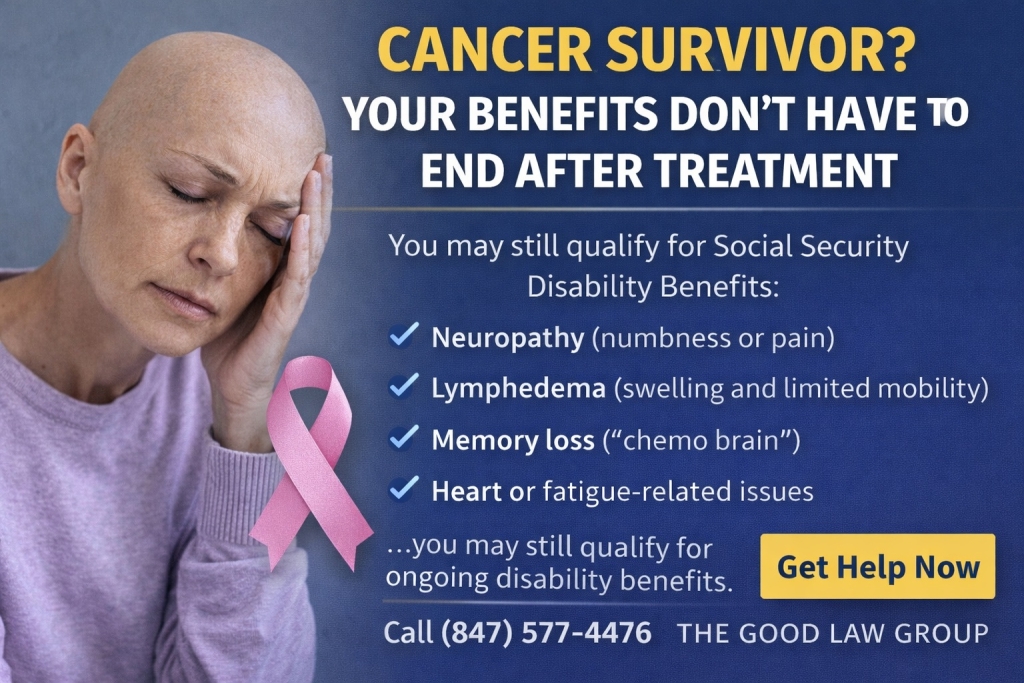
Four common side effects that may qualify you for disability benefits:
- Neuropathy: Numbness in the hands and feet that may require a walker or prevent you from holding objects.
- Lymphedema: Swelling, often after breast cancer surgery, that limits the use of limbs.
- Memory loss: Difficulty remembering information or performing simple tasks.
- Heart problems: Issues that arise from treatment, affecting stamina and strength.
If you’re facing any of these conditions and need to reapply for Social Security disability benefits—or if your benefits were unexpectedly stopped—it’s crucial to understand that you can take action. Don’t assume that the initial approval is all you’ll get. There are options to appeal and reapply based on your current condition.
If you have questions or need assistance with a Social Security disability case, please contact The Good Law Group. We’re here to help you navigate the complexities and secure the benefits you deserve. Call us at (847) 577-4476.
How the SSA Evaluates Cancer and Post-Treatment Conditions
The Social Security Administration (SSA) evaluates cancer claims under its Blue Book listings, but ongoing eligibility often depends on what happens after treatment ends.
The SSA looks at:
- Whether your cancer is active, recurrent, or metastatic
- The type and intensity of treatment (chemotherapy, radiation, surgery)
- Residual side effects after treatment
- Your Residual Functional Capacity (RFC) — what you can still do despite limitations
If your cancer is no longer active, your claim will often be evaluated based on your functional limitations, not the diagnosis alone.
Why Benefits Sometimes Stop After One Year
Many cancer-related disability approvals are granted with a medical improvement expected (MIE) designation. This means:
- The SSA expects your condition to improve
- Your case will be reviewed after a set period (often 12 months)
- Benefits may stop unless you prove ongoing disability
This is where many survivors run into problems—not because they are no longer struggling, but because they don’t provide updated medical evidence.
How to Qualify for Ongoing Disability Benefits After Cancer
To continue receiving benefits, you must show that your condition still prevents you from working.
Key ways to strengthen your case:
✔️ Updated medical records showing ongoing symptoms
✔️ Doctor statements explaining long-term limitations
✔️ Residual Functional Capacity (RFC) forms
✔️ Documentation of how symptoms affect:
- Standing, walking, or sitting
- Concentration and memory
- Ability to complete tasks consistently
What to Do If Your Benefits Were Stopped or Denied
If your benefits were cut off or your claim was denied, you still have options:
- Request reconsideration
- Appeal for a hearing before an Administrative Law Judge (ALJ)
- Submit new and updated medical evidence
- Work with a disability attorney to build a stronger case
🚫 Avoid this mistake: Don’t simply reapply without addressing the reason for denial. Appeals are often more effective.
FAQ
Can cancer survivors qualify for Social Security disability benefits?
Yes. Cancer survivors may qualify for SSDI or SSI if their cancer or treatment side effects prevent them from working. Even if the cancer is no longer active, ongoing problems like neuropathy, lymphedema, fatigue, heart damage, or memory loss may still support a disability claim.
Can you get disability for cancer treatment side effects?
Yes. The Social Security Administration may approve benefits based on long-term side effects from cancer treatment. Common qualifying issues include neuropathy, lymphedema, cognitive problems, weakness, chronic fatigue, and heart complications.
Why do Social Security disability benefits sometimes stop after cancer treatment?
Some cancer claims are approved with the expectation that the person may improve after treatment. When the SSA reviews the case later, benefits can stop unless updated medical evidence shows that serious limitations still exist.
What medical evidence do cancer survivors need for disability benefits?
Strong evidence includes oncology records, imaging and lab results, treatment history, hospital records, specialist notes, and a Residual Functional Capacity (RFC) form from your doctor explaining how your symptoms limit your ability to work.
Can chemo brain qualify you for disability benefits?
Yes. Memory loss, difficulty concentrating, slowed thinking, and other cognitive issues after chemotherapy may qualify if they significantly interfere with your ability to perform work tasks consistently and safely.
What should I do if my cancer-related disability benefits were stopped?
You should review the notice carefully and appeal on time. It is important to submit updated medical records and documentation showing that your treatment side effects still limit your daily activities and work capacity.
Can neuropathy from chemotherapy qualify for SSDI?
Yes. Chemotherapy-related neuropathy may qualify if numbness, pain, weakness, or balance problems make it difficult to stand, walk, use your hands, or complete regular job duties.
Do I need a disability lawyer for a cancer-related claim or appeal?
You are not required to have a lawyer, but legal help can make a big difference. A disability attorney can gather the right evidence, meet deadlines, and present a stronger case if your benefits were denied or terminated.
You’re Not Alone — And You Still Have Options
If you’re facing any of these conditions and need to reapply for Social Security disability benefits—or if your benefits were unexpectedly stopped—it’s crucial to understand that you can take action. Don’t assume that the initial approval is all you’ll get. There are options to appeal and reapply based on your current condition.
💙 Get Help Securing the Benefits You Deserve
Cancer recovery is a long journey and you shouldn’t have to fight for benefits on your own.
At The Good Law Group, we help cancer survivors:
✔️ Prove ongoing disability after treatment
✔️ Navigate benefit reviews and terminations
✔️ Build strong medical evidence for appeals
✔️ Maximize chances of approval
📞 Call (847) 577-4476 for a FREE case evaluation
No upfront fees. No risk. Just experienced help when you need it most.