


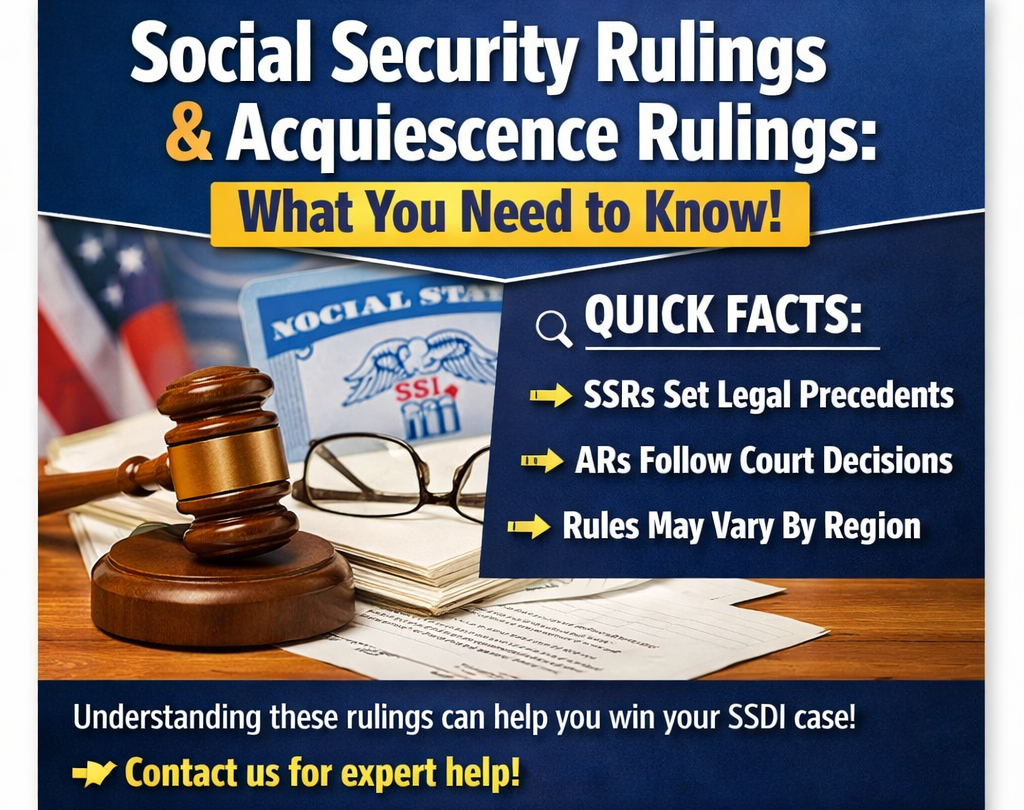
In an ideal world, you could simply read the Social Security Rulings and understand everything based on the original wording. In the real world, how officials interpret and apply the rules matters. Whenever this leads to a dispute, the resulting rulings can change how the rules will work in future cases. Understanding and citing such rulings can help get you the benefits you deserve.
The rulings fall into two main categories. Social Security Rulings set a precedent on how to apply the law. Acquiescence Rulings detail how the SSA changes its policies after a ruling by a US Court of Appeals. Read on to learn more about both of these topics.
What Are Social Security Rulings?
While Social Security Rulings(SSR) can come from a wide range of sources, the common factor is that they are precedential. That means they establish a legal principle that bodies such as courts and tribunals will take into account when they hear future similar cases. Precedent usually deals with cases where the existing legal situation is ambiguous. Sometimes it’s because the original wording of a law or rule was unclear. Often it’s because something happened that the writers of the original rules didn’t anticipate.
Sources And Process of SSR
An SSR is a specific category of rulings published by the SSA in the Federal Register. A ruling published under this category becomes a formal part of the SSA’s procedures. While a Social Security Ruling is not technically a law or regulation in itself, the SSA is required to follow the ruling whenever it is relevant to a future case.
Each Social Security Ruling can originate from one or more sources including:
- A Federal court making a ruling.
- The Office of the General Counsel (the legal team of the Department of Health and Human Services) giving a legal opinion.
- The Commissioner of Social Security making a decision.
- The SSA changing or updating its policies.
How an SSR Works
To understand how an SSR works, here’s a real example. The SSA has a set of rules for how it determines the “established onset date” in blindness cases. This is the date when, for the purposes of calculating benefits, the blindness began.
In principle the rules were simple: the established onset date is the earliest date on which the claimant:
- met the legal definition of blindness;
- met the legal definition of disabled (if relevant); and
- met the relevant non-medical requirements (such as insurance status.)
In practice, some cases led to ambiguity over the correct timetable to use, such as with:
- somebody who qualifies for benefits through blindness but also qualifies though another impairment; or
- somebody who qualifies for benefits through blindness but is still working.
The SSR clarified how the rules work in such cases. It was published in the Federal Register on 2 October 2018 and the SSA must follow it for all claims that were pending on this date or were made after it.
Primary Headache Disorder Cases – SSR 19-4p – watch our video

What Is the Acquiescence Ruling?
An Acquiescence Ruling also changes the way the SSA implements its rules, but has a couple of key differences from an SSR.
The first is that it directly follows a decision by a United States Court of Appeals that goes against the SSA’s existing policies. The most common example is the court overturning the SSA’s decision that somebody in a specific situation isn’t entitled to benefits.
When this happens, the court issues an Acquiescence Ruling that is published in the Federal Register. The ruling specifically details why the court rejected the SSA’s previous policy and interpretation and how the SSA must change the way it handles future similar cases. As with an SSR, an Acquiescence Ruling isn’t a law or regulation in itself, but the SSA does have to follow it, and it could be cited in future cases.
The second difference is that an Acquiescence Ruling doesn’t change the SSA’s actions across the country. Instead it only affects cases in the relevant circuit (geographic region) of the Court of Appeals that issued the ruling.
How an Acquiescence Ruling Works
An Acquiescence Ruling from February 2020 followed a case heard by the Sixth Circuit Court of Appeals.
One aspect of the case involved the evidence claimants put forward when applying for benefits. The SSA’s national policy is to disregard evidence when it believes the provision of that evidence involved fraud. It doesn’t take any notice of whether the claimant objects to it disregarding the evidence.
The Court of Appeals ruled that the claimant should have the right to challenge the SSA’s belief that fraud was involved.
The Acquiescence Ruling explains how the SSA will change its procedures in cases in the states that come under the Sixth Circuit (Kentucky, Michigan, Ohio and Tennessee.)
If a claimant challenges the decision to disregard evidence, an adjudicator will decide whether the decision stands. They will apply a “reason to believe” standard for assessing the evidence of fraud: this is higher than a mere suspicion, but lower than a “preponderance of evidence” (more likely than not) threshold.
Navigating the SSD Landscape
To show just how complicated Social Security can be, the Federal Register includes more than 13,000 Social Security Rulings and Acquiescence Rulings since 1994. Understanding which rulings apply to a particular case is vital to making sure a claimant can exercise their legal rights, whether this means persuading the SSA to act correctly or making an argument at a tribunal or court case.
Things get even more complex when you look at Acquiescence Rulings only covering a specific “circuit.” In practice this means the effective rules for Social Security may vary depending on the claimant’s location and advice that doesn’t take account of the relevant rulings may be inaccurate.
✅ Frequently Asked Questions
What is a Social Security Ruling (SSR)?
A Social Security Ruling (SSR) is an official SSA policy interpretation that sets a precedent for how the SSA handles future cases. While not law, it carries legal weight and must be followed by SSA decision-makers when applicable.
How do SSRs affect my disability case?
SSRs clarify how the SSA applies its rules, especially when the law is unclear or ambiguous. If your situation matches a past case addressed by an SSR, the SSA must follow the same interpretation when reviewing your claim.
Where do Social Security Rulings come from?
SSRs can come from federal court decisions, legal opinions from the SSA’s legal team, decisions by the Commissioner of Social Security, or internal SSA policy updates. All SSRs are published in the Federal Register.
What is an Acquiescence Ruling (AR)?
An Acquiescence Ruling is issued when a U.S. Court of Appeals disagrees with how the SSA has applied the law. It tells the SSA how to change its policy in that circuit’s region only, based on the court’s decision.
Do Acquiescence Rulings apply nationwide?
No. Acquiescence Rulings apply only within the specific federal court circuit that made the ruling. This means Social Security rules can work differently depending on what state you live in.
Can rulings help win a disability claim?
Yes. Knowing and correctly citing an SSR or AR relevant to your case can strengthen your legal argument, clarify gray areas, and ensure the SSA follows proper procedure, especially during hearings or appeals.
How can I find out which rulings apply to me?
With over 13,000 rulings published, it can be overwhelming. An experienced Social Security disability attorney, like those at The Good Law Group, can identify and use the rulings that apply to your specific situation.
Why should I work with a disability attorney on SSR/AR issues?
These rulings are complex, technical, and constantly evolving. A skilled attorney understands how to apply them effectively in your case, whether you’re facing denial, appealing a decision, or preparing for a hearing.
Fortunately expert organizations such as The Good Law Group are highly skilled and experienced in not only using Social Security laws when fighting your case, but also in taking account of rulings to help you exercise your rights whenever and wherever you have a problem. Contact The Good Law Group for a complimentary case evaluation (847) 577-4476 .